|
|
|
One thing you can count on with waves:
there's always another one right behind the one that just knocked you off
your board. The trick is to make sure you're back up on your board when the
next swell hits.
Starting at the end of fiscal 1998, we got knocked
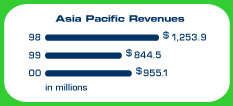
pretty silly in Asia Pacific. Revenues dropped by about one-third. Japan,
which accounted for half of our Asia Pacific revenues, was awash with
excess inventory. We spent much of fiscal 1999 in rehab, reducing our
regional cost structure and putting in place a plan designed to capitalize
on the abundant opportunities in the marketplace.
Over the past year, we began to harvest the first
fruit from that reorganization. While revenues grew at 13 percent (or
five percent in constant dollars), profitability improved quite dramatically.
Gross margins saw marked improvement in fiscal 2000 and, although they
did not reach the peak levels of a few years back, we are enthused about
the potential to drive strong gross margin performance going forward.
We also leveraged our lower cost structure significantly. The net result
was a very sharp increase in our regional bottom line.
Japan remains the bellwether market for us in Asia
Pacific and our recovery there in fiscal 2000 reflects our ability to
adapt to rapidly shifting consumer tastes. Innovations have consistently
drawn Japanese consumers to Nike products and cutting-edge introductions
such as the Presto and Air Kukini have helped re-ignite demand.
Japan, however, is something of an aberration relative
to most other markets in the region. In many emerging markets, the cost
of a current Nike shoe can be too expensive for most young people who
are passionate about sports. Our World Shoe Project provides regions
like China and Southeast Asia with a line of affordable athletic shoes
that meet specific sport needs, and are designed and manufactured with
proven Nike technology. Shoe costs are kept low because there are fewer
and less expensive components than the current more sophisticated models,
lower transportation and shipping costs, and no import duties.
After the devastating earthquake in October, our offices in
Taiwan were effectively shut down for a month. When we rang the bell at the end
of the fiscal year in May, Nike Taiwan made their budget for the year with some
change left over to spare. In turn, Asia Pacific contributed more than its fair
share to our improved profit picture. And NIKE, Inc. earned 32 percent more per
share than we did last year.
We enter the new fiscal year with the two most compelling
weeks in sports about to unfold in Sydney. Cathy Freeman runs for all
of Australia. Hicham El Guerrouj runs to make up for a misstep in Atlanta.
Michael, Maurice and Marion — well, they just run really fast. Sometimes
even the grown-ups get to play on the playground.
Will the Olympics inflame the passion of sports in
every consumer in Thailand, Korea, and China? Not likely. Will people
watch? Ask all the advertisers who wish to align themselves with the
power of sports every four years or so. Will something happen that you've
never seen before? Maybe. Frank Deford of Sports Illustrated says that
the best thing about covering sports is that everyday, somebody wins.
|
|